
The Integrator: The Role Most SMEs Need but Rarely Hire For
Somewhere between the strategy set in a boardroom and the work happening on the shop floor, there's a role that rarely appears on an org chart. It's the role that makes sure what the business decided to do actually happens, at the standard agreed, in the timeframe committed.
It doesn't need a senior title to be valuable. In most businesses under £10m in turnover, it doesn't need to be full time. What it does need is someone dedicated to closing the gap between what's decided above and what's delivered below.
The name for it, when you read enough books on operating rhythm, is integrator.
Where the gap shows up
Most founder-led SMEs have both sides of the equation. A strategy, however informal. An operations team, however stretched. The gap isn't in the ingredients. It's in the connection between them.
It shows up in familiar ways. Targets that keep sliding because the plan doesn't reflect what's deliverable. Teams flat out on the wrong problems. Investment decisions made on assumptions rather than evidence. Reports that describe what happened without explaining why. A gradual drift between what the leadership team believes is happening and what actually is.
Most of this is not visible in a set of management accounts. It only surfaces in conversation, on the floor, with the people doing the work.
What an integrator actually does
Done well, the role has three consistent elements.
Listens properly on the floor
Gives the people delivering the work enough time to explain what the day looks like, what's getting in the way, and what's being asked of them that can't be done with what they've got. The barriers that rarely make it into a board pack.
Argues properly in the boardroom
Takes that understanding upstairs, not as a list of complaints, but as a grounded read of where the business needs to invest. Which barriers are worth removing. Which aren't. What changes would actually move the numbers.
Connects the two
Ensures strategy is rooted in what's deliverable, and the operational side has what it needs to deliver it. Both sides feel heard. Both sides make better decisions.
It is, fundamentally, a translation role.
Why founder-led SMEs need this most
Larger businesses build this function into their structure, often through a COO, a chief of staff, or a [LINK: programme management office]. Businesses under £10m rarely can. The founder, the operations lead, and the management team are usually stretched across multiple functions. The integrator layer gets absorbed into whoever has the capacity, which is usually no one.
The result is the gap widens quietly. Good decisions fail to land. Good people become demotivated. Good investments produce disappointing returns, because the conditions for them to work weren't created on the floor.
How PeakRatio helps
PeakRatio works with founder-led SMEs to provide the integrator function on a fractional basis. Usually a couple of days a month is enough to change the trajectory.
The work is practical. Time on the ground with the operational team. Clear, useful translation back to leadership. A shared view of which barriers are worth removing, and which aren't. Investment decisions made with evidence rather than assumption.
The outcome most businesses see is clear: delivery improves, leadership makes sharper calls, and the value that was quietly leaking between strategy and execution starts showing up in the numbers instead.
Book a discovery call at https://peakratio.co.uk/contact
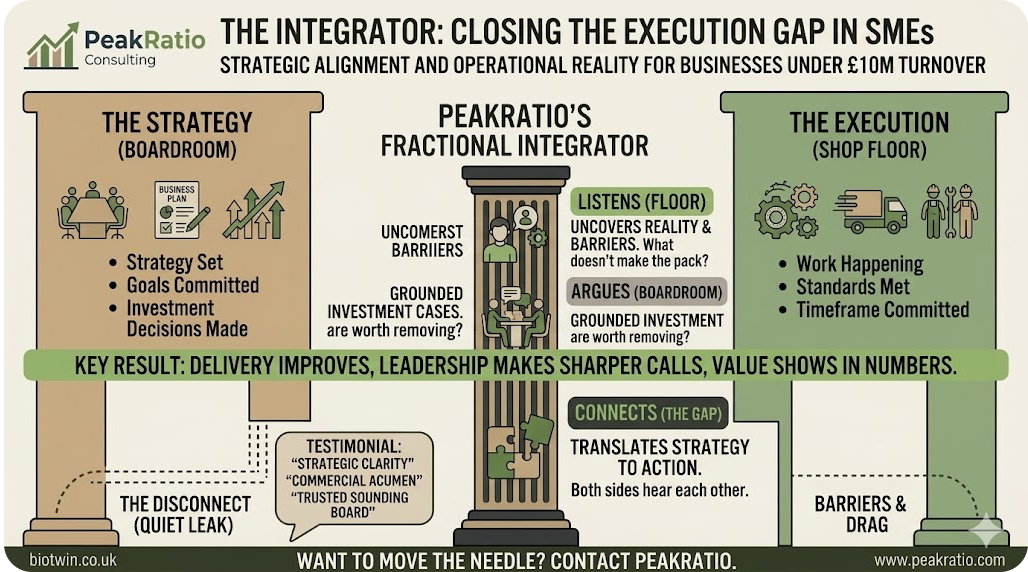
The integrator bridges strategy and execution — the missing link in most growing businesses.
