How I run monthly management reporting for three businesses on under £20 a month
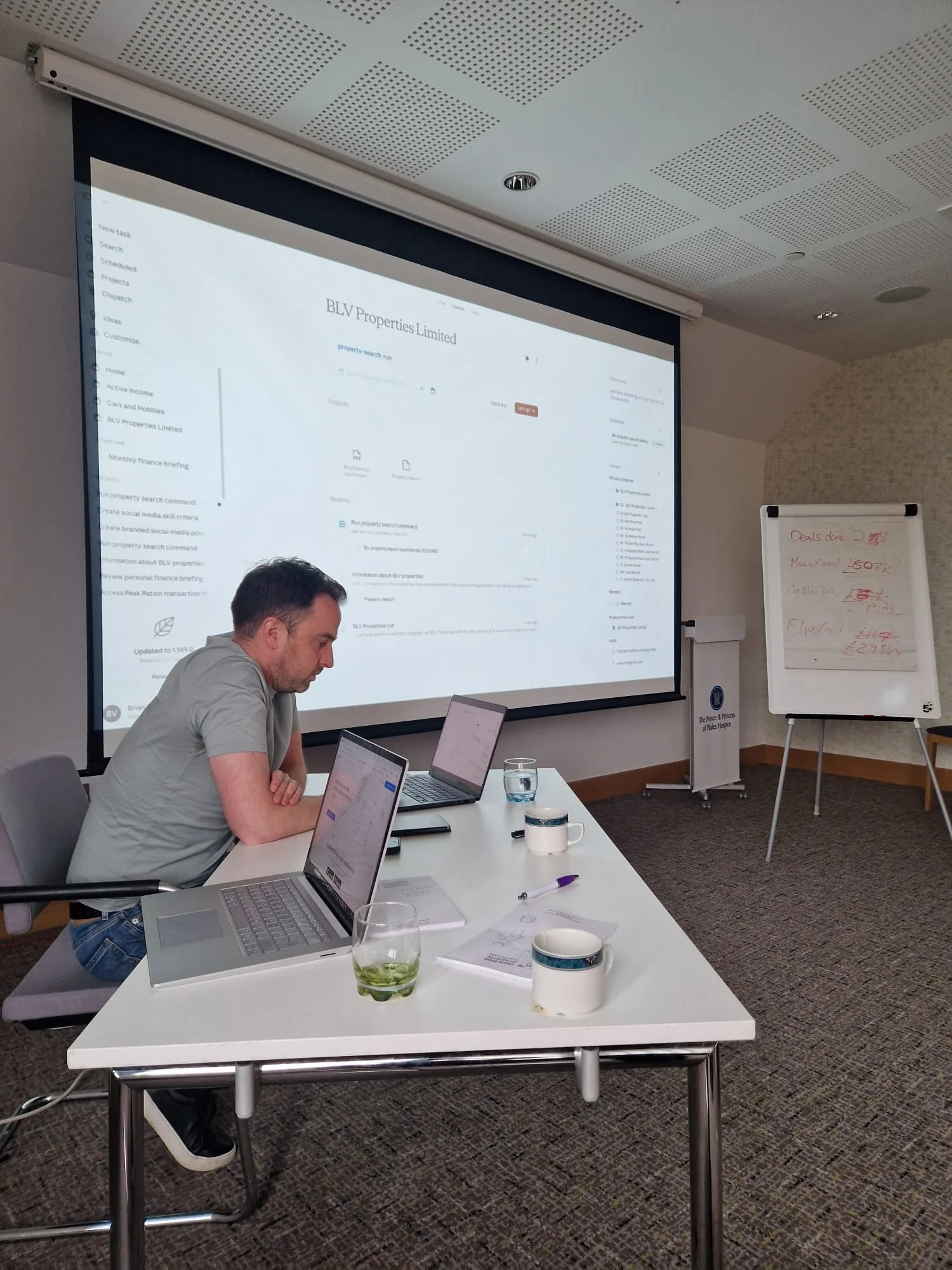
I recently presented to the More Than Property mastermind in Glasgow, a peer group of property investors at various stages and scales. The topic was how I use AI to automate monthly financial reporting and compliance across three different businesses. The reaction in the room was what prompted this write-up: the setup is straightforward, the cost is small, and most SME directors in the room realised they could do the same thing inside a weekend.
This is how it works and why it matters.
The problem most SME directors don't name
Running a business means making decisions on imperfect information. The usual answer is a bookkeeper who produces management accounts a few weeks after the month ends, or accounting software that technically shows you the numbers but rarely shows you what to do about them. Either way, by the time you have a clear picture of last month, you are already halfway through this one.
The gap between reality and reporting is where decisions get delayed, or made blind. For a founder-led SME, that gap is expensive.
What I actually built
I run three sets of books: my personal finances, BLV Properties (my property investment company), and PeakRatio (my advisory business). Each has its own business bank account with downloadable transaction feeds. I maintain a single Excel file that holds the month's forecast for each entity, the current portfolio status (mortgage renewal dates, compliance deadlines, insurance dates), and running account balances.
On the 24th of each month, I run a custom AI skill. It takes three inputs: the updated Excel file, and the latest bank transaction exports for both business accounts. It produces one management-level briefing that covers all three entities.
What the briefing actually contains
The output reads like a monthly board pack, not a transaction log. Specifically it covers:
Reconciliation of actual transactions against the monthly forecast, with variance called out by line
Rent matching for each property: expected versus received, with any mismatches or missing rents flagged for follow-up with the letting agent
Unusual transaction review: anything out of pattern in either business account, flagged with context
Property portfolio status: upcoming mortgage renewals, compliance dates, insurance renewals, all with days-to-action
Director-level KPIs: cash position, monthly income, pressure-free income gap, progress against annual targets
Discussion points: the things I need to think about or act on this month
What it does not do
This is not a replacement for an accountant at year end. It is not a bookkeeping system. It does not file tax returns. What it does is give me the thing I actually need as a director: a clear, timely, management-level picture of where each business is and what to do about it.
Why £20 a month is enough
The ongoing cost is one AI subscription, which at time of writing is around £20 a month. The bank transaction downloads are free from the bank. The Excel file is something I already maintained anyway. The skill itself sits inside the AI tool and runs on demand.
Compare that to the cost of a bookkeeper producing delayed management accounts, or the time cost of a founder pulling the numbers together manually each month, and the economics are obvious. The real saving is not the money. It is the speed at which decisions can now be made on reliable information.
What this has meant in practice
The monthly briefing takes minutes to produce instead of hours. I see rent mismatches the same week they happen, not the following quarter. Compliance dates never get missed. Unusual transactions get questioned while they are still fresh. Most importantly, I spend time thinking about what the numbers mean rather than assembling them.
The conversations I now have in my business are about decisions, not data collection.
How PeakRatio helps SME directors build the same
The More Than Property presentation confirmed something I already suspected: a lot of SME directors are running on reporting systems that are either too slow to inform decisions or too heavy to maintain. The answer is not more software. It is the simplest possible system that produces the information you actually need, when you actually need it.
PeakRatio works with founder-led SMEs to design and implement that kind of system. Sometimes it uses AI. Sometimes it does not. The question is always the same: what is the smallest, most reliable set of monthly numbers you need to run this business well, and how do we make sure you get them every month without friction?
If you are a director who currently relies on delayed management accounts, or who would struggle to answer the question 'how did last month actually go?' with confidence, this is a conversation worth having.
To find out how PeakRatio could help you build lightweight, director-level reporting for your business, visit here to book a discovery call - https://peakratio.co.uk/contact