
Fractional COO: 10 Questions SME Owners Are Actually Asking
Interest in fractional senior leadership has grown significantly over the past few years, but a lot of the content out there is either too vague or too focused on the US market. These are direct, honest answers to the questions UK SME owners are actually searching for.
If you are considering fractional operational support, or simply trying to understand what the role actually means, this is a plain-language guide to the decisions and expectations involved.
1. What Does a Fractional COO Actually Do?
A Fractional COO (Chief Operating Officer) is a senior operational leader who works with your business on a part-time or fixed-term basis, giving you access to C-suite capability without the full-time cost or permanent headcount commitment.
In practice, the role takes ownership of the operational engine of the business. That means making sure day-to-day activity runs efficiently, the right processes are in place, performance is measured against meaningful metrics, and the leadership team is aligned behind a clear execution plan.
More specifically, a Fractional COO typically covers:
Diagnosing operational bottlenecks and inefficiencies
Building or improving systems and workflows
Translating strategy into executable plans
Improving financial performance and commercial outcomes
Managing cross-functional priorities and reporting directly to the founder or CEO
The most important distinction: a Fractional COO is embedded in the business, attending leadership meetings, making decisions, and being accountable for results. They are not producing a report and walking away.
At PeakRatio, this is precisely the gap we work in: the space between a well-articulated strategy and a business that consistently executes on it. Most SMEs do not lack ambition. They lack operational infrastructure. That is what a good Fractional COO addresses.
2. How Do I Know If My Company Needs a Fractional COO?
There are several consistent signals that a business is ready for Fractional COO support, and they tend to appear in clusters.
The most common is that the founder or MD is doing everything. They are simultaneously across sales, operations, delivery, HR, and finance. The business is growing, but so is the chaos. There is no time to step back, build structure, or think strategically.
Other signals to look for:
Revenue has grown but margins have not kept pace
The team is growing faster than the systems can support
Strategic priorities keep slipping because no one owns execution
You have tried to delegate but things fall apart without your direct involvement
You are preparing for a significant change, such as a new market, an acquisition, or an investment round
If two or three of those are familiar, the question is not whether you need support. It is what it is costing you not to have it.
A useful diagnostic: can your business name its three highest-leverage operational priorities right now, and identify who owns each one? If the honest answer to all three is "me", that tells you something.
3. Fractional COO vs Full-Time COO: Which Is Right for My Business?
The answer depends primarily on the size, stage, and complexity of your business, and how continuous your operational needs actually are.
When a full-time COO makes sense
A full-time COO is appropriate when you are running a business of 100-plus people, your operational complexity requires daily senior oversight, and you can sustain a salary that realistically runs from £90,000 to £180,000 per year before benefits and on-costs. Even then, finding the right person typically takes three to six months.
When a Fractional COO makes sense
A fractional model works when you need senior operational capability but not necessarily full-time, during periods of transition, scaling, course-correction, or foundation-building. For businesses turning over £500k to £10m, the economics are often significantly more favourable, and the flexibility to adjust the engagement as needs change is a genuine advantage.
There is also an underrated benefit: a Fractional COO typically brings pattern recognition from working across multiple businesses simultaneously. A full-time hire sees only one.
For most SMEs in the £1m to £8m turnover bracket, a well-scoped Fractional COO engagement will outperform a full-time hire in terms of impact per pound spent.
4. What Is the Difference Between a Fractional COO and a Business Consultant?
This is one of the most important distinctions to understand, and it is frequently misunderstood.
A business consultant produces analysis and recommendations. They diagnose, they report, they present findings, and then they leave. The value they deliver is in the thinking. Whether anything gets implemented depends entirely on you and your team.
A Fractional COO is operationally embedded. They are not producing a report about your business. They are working inside it. They sit in leadership meetings, manage priorities, build systems, and hold people accountable to outcomes. The value is in execution, not just analysis.
A consultant can tell you that your margin problem is rooted in poor job-costing discipline. A Fractional COO will build the job-costing process, train the team to use it, and track the improvement weekly.
PeakRatio sits firmly in the latter camp. Our work is outcome-focused rather than advisory-only. We work in the gap between strategy and execution, ensuring businesses do not just understand what needs to change, but that the change actually happens and can be evidenced in the numbers.
5. Is a Fractional COO Worth the Investment for Small Businesses?
For most SMEs, yes, but the value depends on whether the engagement is scoped correctly and whether the business is genuinely ready to act on what surfaces.
The value of a Fractional COO comes from identifying and addressing the highest-leverage operational problems in the business. In a small business, these problems often have outsized impact: a broken billing process, a margin leak in delivery, a pricing structure that does not reflect actual costs, or a team structure that creates bottlenecks rather than removes them.
The ROI calculation is fairly straightforward. If a Fractional COO costs £3,000 to £5,000 per month and identifies a margin improvement worth £80,000 to £100,000 per year, the investment pays for itself many times over. The challenge is that SME owners often categorise advisory spend as a cost rather than a lever, particularly when cash is tight. That framing tends to keep the problems in place.
The honest caveat: if the founder is not genuinely willing to change how things work, the value will not land regardless of the quality of the thinking. Readiness matters as much as capability.
6. What Does ROI Look Like With a Fractional COO?
ROI from a Fractional COO engagement typically shows up in three places: margin improvement, capacity recovery, and revenue enablement.
Margin improvement
Identifying where the business is leaking money, whether through pricing, procurement, contract management, overhead structure, or debtor recovery. These are often the fastest wins because the problems already exist. Someone just needs to be accountable for fixing them.
Capacity recovery
Freeing up the founder or leadership team from operational fire-fighting so they can focus on the things only they can do: relationship development, strategic decisions, growth activity. The value here is harder to measure but often transformative.
Revenue enablement
Building the operational infrastructure that allows the business to pursue growth it previously could not handle. More reliable delivery, scalable processes, and a commercial model that does not break under pressure.
To give a concrete frame: one engagement resulted in £100,000 of annual profit restored within four months through focused commercial and operational work. In another, £400,000 in new revenue was generated in 12 months by repositioning the proposition and building the commercial infrastructure to support it. These are not exceptional outcomes. They reflect what focused operational attention produces in businesses where the foundations have not been properly built.
7. What Are the Top 3 Objectives a Fractional COO Should Accomplish?
Every engagement is context-specific, but most Fractional COO mandates resolve around three core objectives.
1. Operational clarity
Building an accurate picture of how the business actually functions: where value is created, where it is lost, what the real constraints are, and what the leadership team is currently blind to. This diagnostic work underpins everything that follows.
2. System and process improvement
Addressing the specific operational problems that are limiting performance. This might be financial (margin analysis, forecasting, billing), people-related (team structure, accountability frameworks, performance management), or commercial (pipeline visibility, pricing discipline, contract management). The objective is not process for its own sake. It is building the infrastructure the business needs to perform consistently.
3. Leadership leverage
Making the founder or MD more effective by removing the operational burden that should not be sitting with them. A good Fractional COO is always building the business's internal capacity, not creating a dependency on their continued involvement.
The best engagements end with the business running better than before, with the internal capability to sustain that improvement. That is the measure of success.
8. How Long Does It Take a Fractional COO to Impact Your Business?
For well-scoped engagements, initial impact is typically visible within four to eight weeks. This does not mean transformation in that timeframe. It means the key problems have been identified, early priorities are being addressed, and the leadership team can already see what is going to change and why.
The diagnostic phase, properly understanding the business, its constraints, and its highest-leverage opportunities, takes two to four weeks in most SME contexts. After that, a well-structured engagement moves quickly, because an experienced Fractional COO is not starting from scratch conceptually. They are applying pattern recognition from previous engagements to your specific situation.
Sustainable operational improvement, where the business genuinely runs differently and the results are evident in the numbers, typically takes three to six months. This is why most Fractional COO engagements are structured as minimum three-month commitments, with many extending to six to twelve months as the scope becomes clearer.
The expectation should not be a quick fix. It should be measurable, evidenced improvement in the operational metrics that matter most to the business, and a clear understanding of where those improvements came from.
9. Fractional COO Pricing Models: Hourly vs Project vs Retainer
There are three main pricing structures for Fractional COO engagements in the UK, each with different trade-offs.
Hourly / day rate
The most flexible but rarely the most efficient. Day rates in the UK typically run from £500 to £1,500 depending on experience, sector, and scope. Hourly works well for clearly time-limited work, but for ongoing operational support it creates uncertainty on both sides.
Project-based
Appropriate when there is a clearly scoped deliverable: a process build, a systems implementation, a commercial review. It gives both parties cost certainty and aligns incentives around delivery rather than time spent. Project fees for SME-level engagements typically range from £5,000 to £25,000 depending on complexity and duration.
Monthly retainer
The most common structure for ongoing Fractional COO work. A fixed monthly fee for a defined number of days, usually two to four days per month, gives the business consistent senior oversight without the variability of hourly billing. Monthly retainers in the UK SME market typically run from £1,500 to £6,000 per month.
For most SMEs, the sensible approach is to begin with a defined diagnostic project before committing to an ongoing retainer. It gives both sides a clear basis for the relationship before a longer-term commitment is made.
Note: the figures above are indicative based on current UK market norms. Actual pricing varies by scope, sector, and the specific experience of the practitioner.
10. Why Founders Are Choosing Fractional COOs Over Full-Time Hires
The shift toward fractional senior leadership is one of the more significant structural changes in how SMEs access operational capability, driven by a combination of commercial, practical, and experiential factors.
Cost is the obvious driver. A full-time COO in the UK costs £90,000 to £180,000 in base salary before on-costs, benefits, or recruitment fees. For a business turning over £2m to £5m, that is a significant proportion of overhead for capability that may only be needed at full intensity during specific periods.
But cost is not the only factor. Founders increasingly recognise that they need different kinds of expertise at different stages. A Fractional COO can be engaged for a specific challenge: a scale-up, a turnaround, a systems overhaul. The engagement evolves or concludes as the business moves on. That flexibility is difficult to replicate with a permanent hire.
There is also the question of speed. An experienced Fractional COO has seen the same operational problems across many businesses. They arrive already knowing what to look for, which accelerates diagnosis and shortens the path to improvement.
The model works when both sides are honest about scope and expectations. Done well, it is one of the highest-leverage investments an SME founder can make.
Working with PeakRatio
PeakRatio works with SME founders and leadership teams who know the business needs to run better, and want a senior operational partner to help make that happen. Our work is diagnostic first, then action-focused. We identify the highest-leverage problems, build the systems to address them, and stay accountable to the outcomes.
If you are considering fractional operational support and want to understand whether it is the right fit for your business, we are happy to have a direct conversation about where you are and what would actually move the needle. Find out more at Peakratio.co.uk.
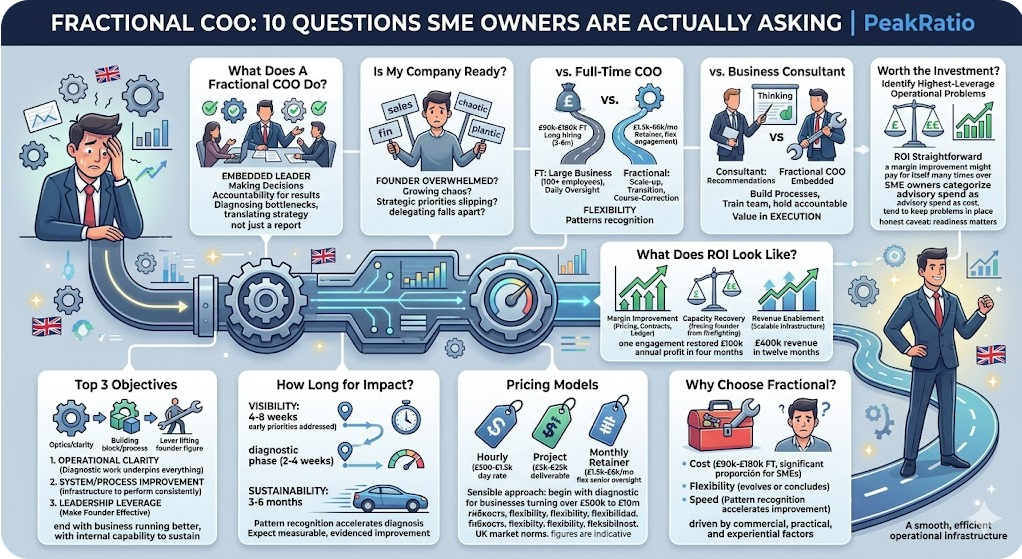
A visual summary of the 10 most common questions SME owners ask before hiring a fractional COO, from role clarity and readiness signals through to pricing models and ROI expectations.
