
Why most system upgrades fail before they're installed
The biggest risk in any new system isn't the software. It's whether your people and culture are ready to use it.
Over the years I've been involved in more system upgrades and process changes than I can count. Document management, finance, planning, ERP, project management, engineering design, permitting, resource management, CRM, material management, estimating, even in-house change management platforms. I've sat through demonstrations, built business cases, sourced new applications, and managed implementations. Alongside that, I've worked on lean manufacturing projects, streamlined processes, updated procedures, and introduced project controls across large EPC projects.
The business cases are always written the same way. The new system will save time, reduce risk, improve reporting, or integrate more smoothly. All of those points are valid. But what I've seen time and again is that the technology or the process itself is never the deciding factor in whether change succeeds.
The biggest impact comes from people and culture.
I've seen "perfect" systems fail because managers didn't use them and their teams followed their lead. I've seen well-documented processes ignored because the culture wasn't aligned behind them. And I've seen average systems deliver outsized value because the people involved were engaged, empowered, and committed to making them work.
Systems and processes are enablers. They only add value when the people using them believe in them, and when the culture supports collaboration rather than silos.
Ask the harder question first
Before your next system upgrade or process improvement, don't start with cost, features, or integration. Start with:
Do we have the culture and the people to make this succeed?
Without that foundation, no system, however advanced, will deliver what you're hoping for.
How PeakRatio helps
This is exactly where we come in. Before you commit to a new system or process, we work with you to align the people and culture that will determine whether it actually delivers. That means getting clear on leadership behaviours, team readiness, and the cultural signals that will either carry the change or quietly kill it. Get that right, and the technology becomes an accelerator instead of a sunk cost.
If you're planning a system or process change and want to pressure-test whether your organisation is ready to make it land, get in touch.
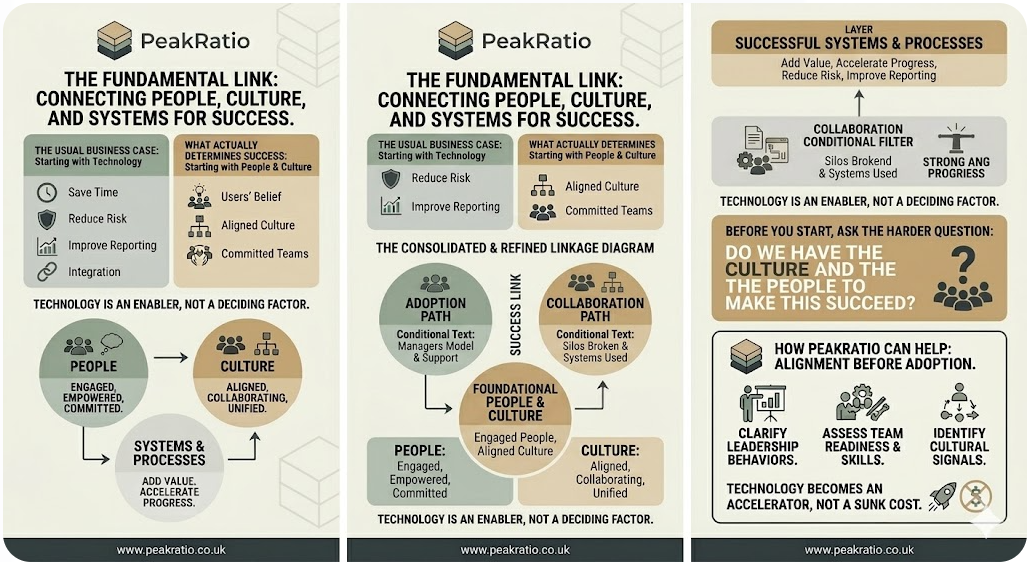
The fundamental link: people and culture are what make systems and processes succeed. Technology is an enabler, not a deciding factor.
