
When Revenue Stalls, the Answer Usually Isn’t in Sales
When revenue stalls in a founder-led business, the first reaction is usually to look at sales. More leads. More activity. A harder target. Fresh incentives.
In most cases, that's the wrong place to look.
This is a pattern PeakRatio sees repeatedly across founder-led SMEs. The sales team is flat out. The pipeline looks healthy. The conversion rate holds steady. But the revenue chart has gone sideways, and nobody on the floor can explain why.
The answer is rarely in the pipeline. It's in the commercial discipline around the work the business is already winning.
Where the profit is usually hiding
There are three places, in order of how uncomfortable they are to look at.
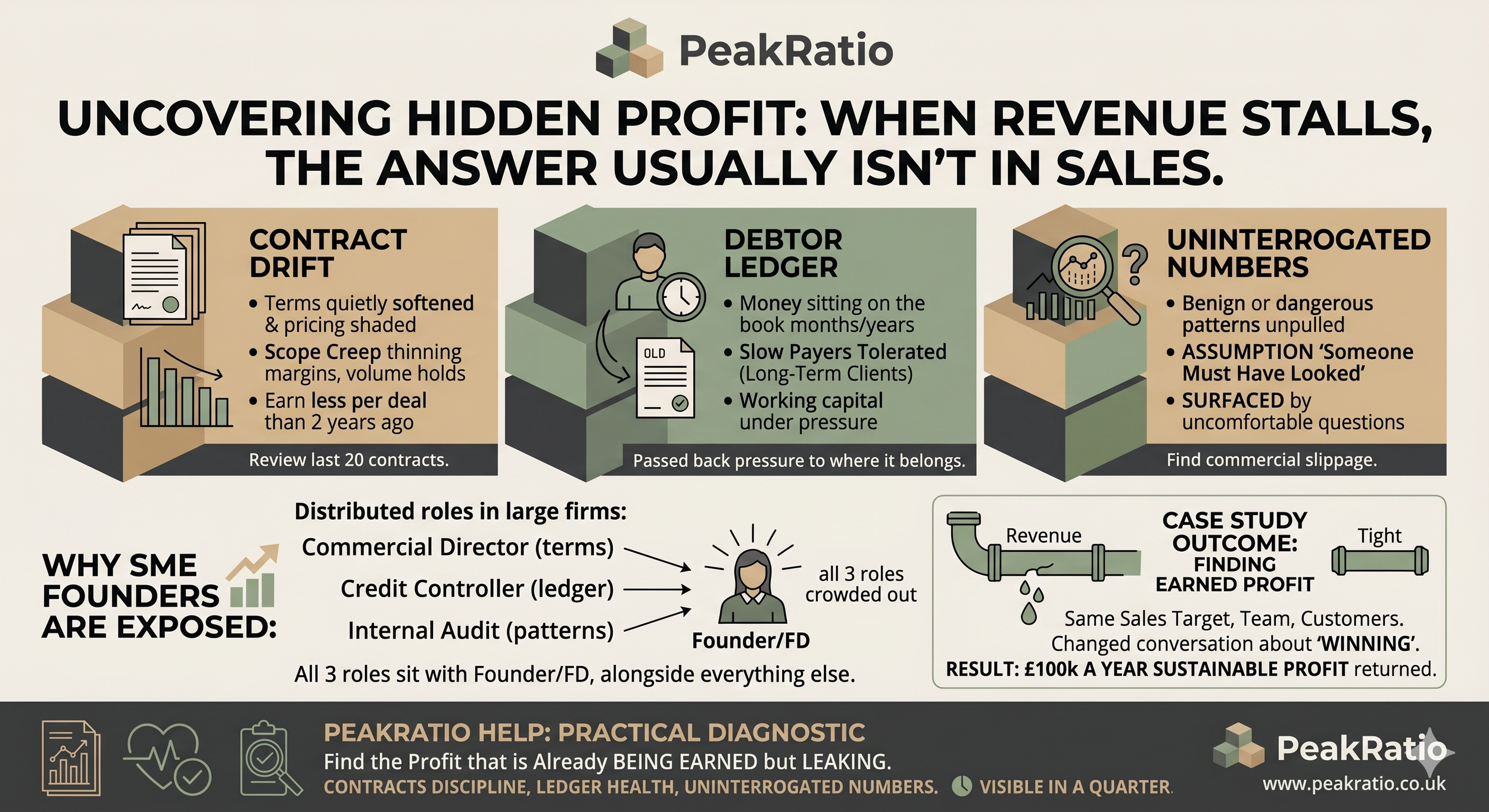
Contract drift
Contracts won over the last eighteen months have been quietly softening. Terms are more generous. Pricing is being shaded to get the deal across the line. Scope is creeping in without a corresponding change to the number. Volume holds. Margin thins. The sales team is hitting their target and the business is earning less on each deal than it was two years ago.
This rarely shows up in a pipeline review. It shows up when someone sits down with the last twenty signed contracts and compares them.
The debtor ledger
Money that should have been collected months ago is still sitting on the book. Slow payers are tolerated because they're long-term clients or because 'they always pay in the end'. Nobody wants to have the call. Working capital is under pressure, but the pressure is being absorbed by the business rather than passed back to where it belongs.
This doesn't show up in a sales report either. It shows up when someone looks at the [LINK: debtor ageing report] in detail, and asks why the top five are where they are.
Patterns in the numbers that have gone uninterrogated
Most SMEs have at least one pattern in the numbers that nobody has properly pulled on. Sometimes it's benign. Sometimes it's not. Either way, the assumption that 'someone must have looked at that already' is usually wrong.
This only surfaces when someone has the time, and the remit, to ask questions that feel uncomfortable.
Why founder-led SMEs are particularly exposed
In larger businesses, commercial discipline is distributed across roles. A commercial director owns the terms. A credit controller owns the ledger. An internal audit function owns the patterns in the numbers.
In a founder-led SME, all three usually sit with the founder or the FD, alongside everything else. The discipline doesn't disappear on purpose. It just gets crowded out by the work of running the business.
The result is profit that has already been earned, quietly leaking back out of the business. Often at a scale the founder would find difficult to believe until it's laid out in front of them.
What changes when someone looks properly
In one engagement, four months of focused work didn't change the sales target. It didn't add a single customer. It didn't change the sales team.
What it changed was the conversation the business was having about what 'winning' looked like. A handful of conversations that should have happened eighteen months earlier finally happened. Contracts tightened. Debtors were chased. The pattern in the numbers was pulled on.
The result was £100k a year of profit coming back to the business, in a form that was sustainable rather than event-driven.
How PeakRatio helps
PeakRatio works with founder-led SMEs to find the profit that's already being earned but leaking out through commercial slippage. The focus is on three things: the terms and discipline of the contracts being won, the health of the ledger, and the patterns in the numbers that have gone unasked.
The work is practical and, in most cases, short. A focused diagnostic followed by a handful of specific changes. The outcome is usually visible in the numbers within a quarter.
Book a discovery call at https://peakratio.co.uk/contact
Why stalling revenue is often an operational or margin problem and where to look first.
