
How Do I Know If My Business Actually Needs Transformation?
Business transformation has become one of those phrases attached to almost any significant change programme, whether a business is genuinely rethinking its model or simply trying to get its existing operations to work properly. For founder-led SMEs, that ambiguity is expensive.
The question, how do I know if my business actually needs transformation, is one of the most common starting points for conversations with SME leaders. It is harder to answer than it sounds, particularly from inside your own business. This article sets out what to look for, why the view from inside is often unreliable, and how to make a clearer call before committing to something significant.
The Diagnostic Problem: You Cannot Always See It From Inside
Early in my consulting career, I was brought in to support a business that appeared straightforward on the surface. The person keeping operations running walked me through where everything stood. Contracts in place, revenue coming in, just needed someone to steady the ship.
By the end of the first day, the picture looked completely different. Half the contracts had not been renewed in years. Several services were running at a loss with no one aware of it. Debtors were 180 days overdue. There was fraud in the supply chain that had been hiding in plain sight for months.
Nobody inside had spotted it. Not because they were not capable, but because they were too close to it. They understood every transaction. They could not see the pattern those transactions were forming.
This is the core diagnostic challenge for any business leader considering transformation. Your proximity to the business shapes what you see and what you miss. The history you have with your processes, the decisions you have invested in, the version of the business you carry in your head over years: all of it creates blind spots that are genuinely difficult to see past.
Transformation vs Operational Improvement: The Distinction That Matters
Before asking whether your business needs transformation, it is worth being clear on what transformation actually means.
Business transformation
Structural and strategic change. It addresses what the business does, how it is organised, and where it is positioned. It involves rethinking the model, not optimising it. That might mean entering new markets, restructuring the organisation, rethinking the service offer, or making a fundamental shift in how value is created and delivered.
Operational improvement
How well the existing model executes. It targets consistency of delivery, reliability of reporting, speed of decision-making, and the elimination of waste. The model itself is not in question. The question is whether it is running as well as it should be.
The two require different tools, different timelines, and different types of leadership attention. Reaching for transformation when you need operational improvement adds cost and complexity to a situation that needs clarity and discipline. And it happens more often than most leaders would acknowledge.
How to Read the Signals in Your Own Business
Start with the fundamentals
Ask whether your core business model is still fit for purpose. Does your offer address a genuine and current market need? Is your revenue model sustainable? Is the strategic direction clear? If the answers are broadly yes, the problem is almost certainly operational, not structural. Operational improvement is the right intervention.
Look at where execution breaks down
Inconsistent delivery, unclear accountability, slow approvals, reporting that nobody trusts, and team effort that does not translate into results are all process signals. They indicate that the operating system beneath a sound strategy needs attention. Transformation will not fix them. In fact, layering transformation on top of poor processes tends to amplify the operational problems rather than resolve them.
Consider what is actually driving the pressure for change
If the business is facing a genuine shift in its market, its competitive position, or its ownership and leadership structure, transformation may be appropriate. But if the pressure is coming from internal frustration with how things are running, the case for operational improvement is almost always stronger.
Why an Outside Perspective Matters
The businesses that navigate this well are the ones that invest properly in the diagnostic phase, not as a formality, but as a genuine exercise in understanding where the business is and what is actually limiting it.
That requires an outside perspective. Not because internal leaders are not capable, but because proximity creates blind spots that are structural, not personal. An experienced adviser with no history in the business, no loyalty to its processes, and no attachment to decisions already made will read the business differently. Often more accurately.
That honest read, before any programme is scoped or committed to, is frequently the most valuable investment a founder-led SME can make.
How PeakRatio Helps
PeakRatio works with founder-led SMEs to provide exactly that: an independent, evidence-based assessment of where the business is and what it actually needs before any commitment is made.
That means separating operational performance issues from structural or strategic ones, identifying the specific processes or foundations limiting performance, and building a clear picture of what needs to change and in what order.
Where operational improvement is the right intervention, PeakRatio helps design and embed it in a way that builds lasting capability rather than just addressing individual symptoms. Where transformation is genuinely required, PeakRatio supports the diagnostic, strategic, and programme foundations that give it the best chance of delivering.
If you are weighing up whether your business needs transformation or something more targeted, visit https://peakratio.co.uk/ to find out how PeakRatio can help you make that call with confidence.
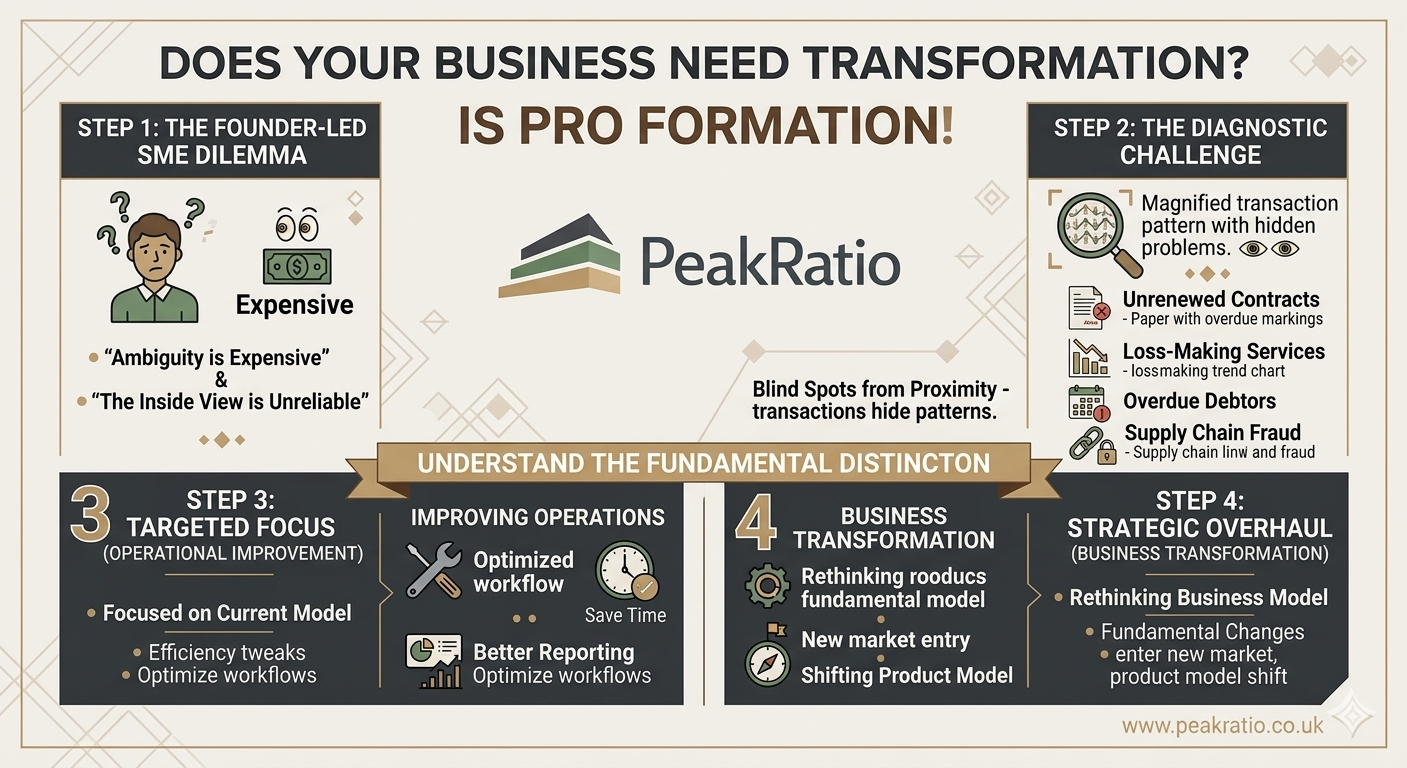
Signs that an SME has outgrown its current model and the questions to ask before committing to change.
